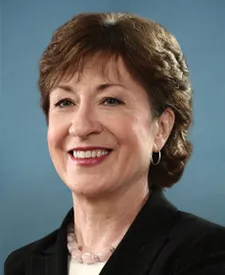
Susan M. Collins
Republican · Senator from Maine
Career totals · 6 elections · 1996–2026
$70.1 million
raised by Collins’s campaigns, everything from 1996 to 2026 added together.
21%
of it came from organized groups rather than from people giving on their own: at least $14.8 million from PACs, plus donations that organizations collected and directed.
$66.3 million
was spent about Collins by outside groups. These are ads for or against them that their campaign cannot control, and none of it is part of the money above.
Every number on this page comes from Federal Election Commission filings, read on October 12, 2026. An election still under way keeps raising money, so its figure will have grown since. Check Collins on FEC.gov
Where the money came from
Everything Collins’s campaigns have reported raising, split by who gave it.
- Individual donorsMoney given by people, in their own name.70%$48.8 million
- Political action committeesOrganized groups: company-run committees, unions, trade associations.18%$12.9 million
- Other sourcesParty transfers, the candidate's own money, loans and smaller categories.12%$8.4 million
Money bundled through organizations
Not every “individual” donation arrives on its own. An organization can collect checks from its members, already earmarked for Collins, and deliver them in a bundle. The law counts that as individual money, but the organization still chose where it went.
$1.9 million
reached Collins this way, 4% of everything they raised from individuals. Each donation came from a real person. The organization picked who got it.
- AIPACThe American Israel Public Affairs Committee's political arm. It backs candidates of both parties it considers strong supporters of the U.S.-Israel relationship.$1.6 million
- NORPACA New Jersey-based pro-Israel PAC that bundles member donations for candidates of both parties.$179,000
- Senate Conservatives FundA PAC founded by former senator Jim DeMint that bundles donations for conservative Senate candidates, often in Republican primaries.$42,000
We can only count the organizations we have measured, so the real figure could be higher than this, never lower. Bundling is legal and widely used, and appearing here is not evidence of wrongdoing.
Who gave the most
Committee contributions from the 2024 and 2026 election periods, grouped by how the FEC classifies each giver. This covers a slice of the career total, and giving to a campaign is legal and ordinary.
- Corporation41%$1.2 million
- Trade association18%$520,000
- Labor union2%$53,000
- Membership organization8%$212,000
- Co-operative<1%$3,500
- Corporation without capital stock1%$32,000
- Unclassified30%$833,000
Which industries
- Technology & telecoms13% · $12,000
- Energy & utilities11% · $10,000
- Transport11% · $10,000
- Real estate & construction11% · $10,000
- Health & pharmaceuticals11% · $10,000
- Banking & finance11% · $10,000
- Defense & aerospace11% · $10,000
- Other22% · $20,000
The FEC records that a committee is a corporation; it does not record its industry. Those labels are ours, kept in a published list anyone can check. Where we have not labeled a giver we say “Other” rather than guessing.
Largest committee givers
- 1Young Victory Committee$72,000
- 2Scott$20,000
- 3Republican Jewish Coalition$14,000
- 4Husted$13,000
- 5National Association of Broadcasters$12,000
Show all 10 giversShow fewer
“Unclassified” means the FEC records no organization type for that committee, which usually means a leadership PAC. We show it as unclassified rather than guessing which industry it belongs to.
Money spent about this member
Outside groups, usually super PACs, may spend without limit on ads for or against a candidate, as long as they do not coordinate with the campaign. Collins has no legal control over any of it.
This is not a donation. Nobody gave this money to Collins. It was spent on advertising about Collins, and money spent against a candidate is plainly not funding them. So it never gets added to the figures above.
$66.3 million
has been spent for or against Collins by outside groups. $12.2 million supported Collins; $54.1 million opposed Collins.
Largest outside spenders
Summed across 3 elections, using the Commission's aggregated totals so amended filings and 24-hour notices are not double-counted.
Spent supporting
$4.8 millionAds urging people to vote for this member. Still not their money, and they cannot direct how it is spent.
- 1820 PAC$2.7 million
- National Association of Realtors Congressional Fund$2.1 million
Spent opposing
$42.8 millionAds urging people to vote against this member. This money was spent to defeat them.
- Senate Majority PAC$27.4 million
- DSCCThe Democratic Senatorial Campaign Committee, the Senate Democrats' official campaign organization.$4.6 million
- Women Vote!EMILY's List's super PAC, spending independently to support Democratic women who back abortion rights.$4.3 million
- Priorities USA Action$2.4 million
Show all 6 groupsShow fewer
- End Citizens United$2.1 million
- American Federation of State County & Municipal Employees P E O P L E$2 million
Election by election
The career figures above are the sum of these elections. Each row links to the Commission’s page for that election, where the numbers match line for line.
| Election | Raised | From PACs | Outside spending | |
|---|---|---|---|---|
| 2026in progress | $18.9 million | $1.8 million 9% | $4.3 million | FEC |
| 2020 | $30.8 million | $3.4 million 11% | $61 million | FEC |
| 2014 | $6.4 million | $2.8 million 44% | $952,000 | FEC |
| 2008 | $8 million | $2.9 million 36% | none | FEC |
| 2002 | $4.3 million | $1.5 million 36% | none | FEC |
| 1996 | $1.7 million | $614,000 36% | none | FEC |
Raised is everything the campaign took in for that election. From PACs is the slice of it given by political action committees. Outside spending is what other groups spent on ads about the race, for and against—it is not part of “Raised”. An election marked in progress is still raising money, so its figures are not final.
We never publish the names of individual donors, and anything we cannot source stays off the page. The methodology explains every such choice.